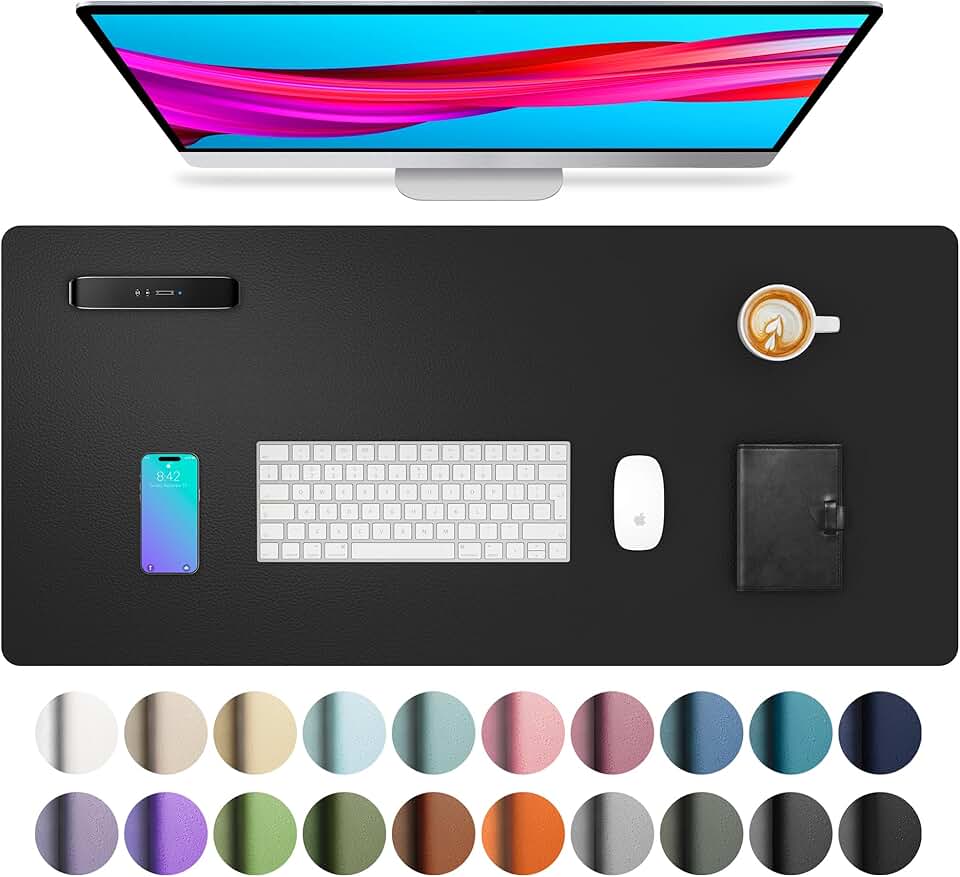
Build Quality
The Aothia desk pad uses a two-layer construction: a smooth PU leather top laminated over a cork suede underside. PU leather at this price point - under $30 for the entry size - is not the same material as a $120 Pad & Quill leather desk mat. Expect a plastic-backed synthetic surface that looks professional under office lighting but will show edge wear and surface scuffs after 12-18 months of daily use. The waterproofing is real - liquids bead and wipe clean rather than soaking through - but PU leather is not puncture-resistant, and a sharp pen tip dragged across the surface will leave a permanent mark.
The cork suede backing is the most defensible quality claim in the whole product. Cork naturally conforms to uneven desk surfaces better than silicone rubber, which means the mat sits flush even on desks with slight warps or texture. Aothia's stated 70% grip improvement over double-sided leather has no published test methodology behind it, but cork is a genuinely better backing material than leather for anti-slip performance - that part holds up physically even without the number.
Comfort and Ergonomics
The mat is flat. It has no wrist rest, no raised front edge, and no cushioning layer. Typing comfort is entirely dependent on your existing keyboard setup - the mat does nothing to change wrist angle or reduce contact pressure. The PU surface is smooth and slightly cool to the touch, which some users prefer over fabric for forearm contact during long sessions. Writers who rest their hand on the surface while writing will find it more comfortable than a bare wooden desk, but less forgiving than a foam-backed fabric mat like the Fellowes Cosmic2 Microban, which retails around $18.
Mouse tracking works on the PU surface, but this is not an optimized mouse pad. Optical sensors read PU leather adequately at standard 800-1600 DPI settings. At 3200 DPI and above, surface texture inconsistencies may cause minor tracking errors. This is a desk protector that tolerates mouse use, not a mouse pad that doubles as desk protection.
Adjustability
There are no adjustable components. Zero. You pick one of three fixed sizes - 23.6" x 13.7", 36" x 17", or 48" x 17" - and that is the product. The 36" x 17" option fits most single-monitor home office desks with space for a keyboard, mouse, and one peripheral. The 48" wide version covers a dual-monitor spread if your monitors sit on arms rather than stands. Measure your usable desk surface before ordering. A 48" mat on a 55" desk with a monitor stand leaves approximately 3.5" of clearance on each side, which is tighter than it sounds.
Assembly
Unbox, unroll, place flat. The cork backing should prevent curling within 24-48 hours if the mat arrived rolled in packaging. If edges curl after 48 hours under ambient temperature, laying heavy books on the corners for 12 hours resolves the issue in most cases. There are no adhesives, no clips, and no tools involved.
Value for Money
The $27.99 entry price for 23.6" x 13.7" - roughly 323 square inches of coverage - works out to about $0.087 per square inch. A Ktrio 35" x 17" fabric mat at $22 delivers 595 square inches for $0.037 per square inch. The Aothia costs more than twice as much per unit of surface area, which is only justified if you specifically need waterproofing or the cork grip advantage. For a kitchen desk where coffee spills are a weekly event, or for a polished hardwood surface where rubber-backed mats still migrate, that premium is defensible. For a standard carpeted home office with a matte desk, the Ktrio or a similar fabric mat is a more rational purchase.