Build Quality
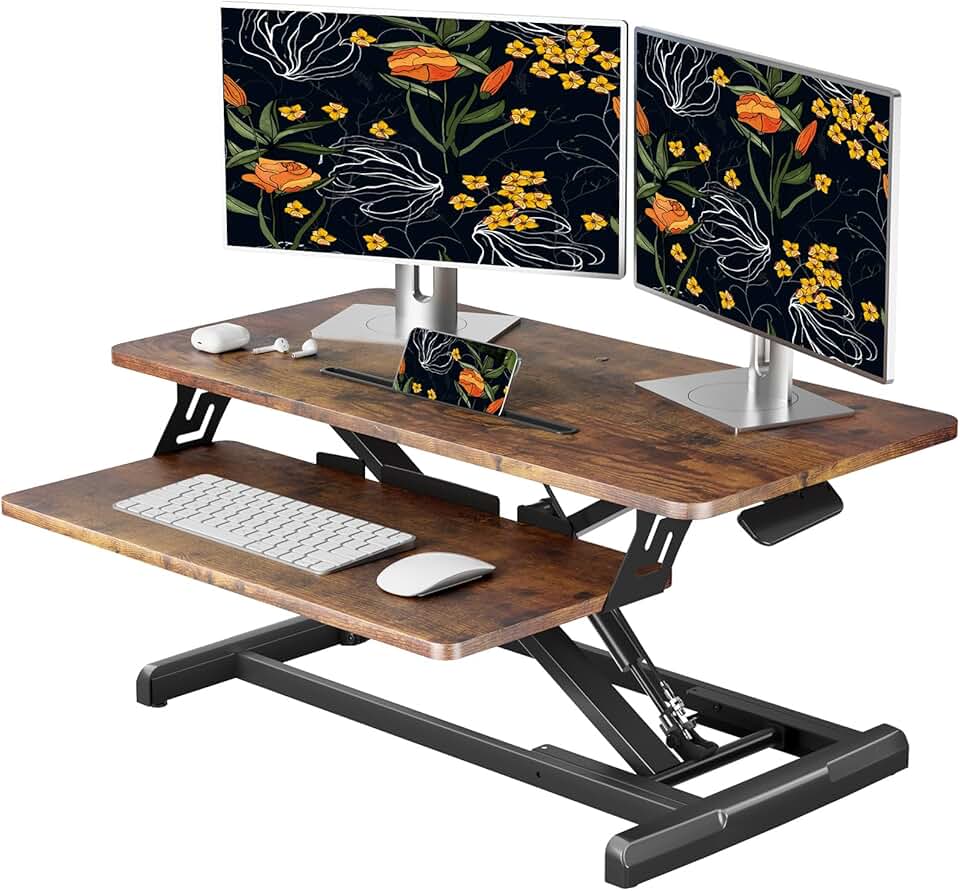
The JOY worker Standing Desk Converter uses a particle board top surface sitting on a patented X-shaped metal frame. The X-frame is the right structural choice - it distributes load more evenly than straight scissor lifts and reduces the side-to-side rocking that plagues budget converters. However, particle board is particle board. At 28.6 lbs of capacity, you are working close to the material's comfort zone, and particle board edges chip and sag over 18 to 24 months of daily use in ways that bamboo or MDF alternatives do not. The 31.5" x 15.7" top tier dimensions are generous enough for two monitors spaced side by side, but the depth is shallow - anything beyond a monitor stand base will feel crowded. The keyboard tray is a real inclusion, not a token one, and keeping your keyboard 3 to 4 inches below the main surface is the correct ergonomic move. No quality control issues specific to 2026 units have been reported, but frame creaks and uneven lift resistance have shown up in earlier production runs of particle board X-frame converters in this category.
Comfort and Ergonomics
The height range of 4.9" to 19.3" above your existing desk surface translates to real-world usability for anyone between 5'0" and 6'2" tall. A person standing at 5'8" typically needs monitor height around 50" to 55" from the floor - and with a standard 30" desk plus this converter at 19.3" max, you land right in that window. Taller users at 6'3" and above will find the 19.3" ceiling leaves monitors too low for neutral neck position. The keyboard tray keeps wrists below screen level, which is the layout most physical therapists recommend for reducing upper trapezius strain during extended typing. The spring-assisted lift requires one hand on the handle to raise or lower, and the transition between sitting and standing takes roughly 3 to 5 seconds - fast enough that you will actually use it throughout the day rather than ignoring it like a crank-handle model.
Adjustability
There is no electric motor, no memory preset, and no app. The JOY worker adjusts manually via a spring-loaded handle lift - you grab, squeeze, and push up or pull down. That simplicity is both its strength and its ceiling. The adjustment range of 14.4" (from 4.9" to 19.3") covers sitting and standing postures for the 5'0" to 6'2" population, but offers zero granularity beyond wherever you choose to stop. There are no click-stop positions at specific ergonomic heights. Users who prefer repeatable height settings - the same standing height every morning - will need to eyeball it or add a piece of tape as a marker. The spring mechanism has shown stiffness in older units over time, though no 2026-specific reports confirm whether this batch improved on that.
Assembly
Converter desks in this category typically require 20 to 40 minutes of setup out of the box, and the JOY worker is no exception. The keyboard tray attachment is the most fiddly step. No power tools are required. The X-frame arrives mostly pre-assembled, and the main surface screws down in under 10 minutes. Placing it correctly on your existing desk - centered, with enough clearance at the back for monitor cable management - is honestly the hardest part of setup. The unit weighs enough that repositioning it after initial placement is a two-person job.
Value for Money
At $258.91, the JOY worker sits in an awkward pricing position. The FlexiSpot EF1 at approximately $150 carries 33 lbs, has a comparable height range of 5.9" to 19.7", and has a stronger long-term durability reputation - making it the more rational purchase for most buyers. The Eureka Ergonomic LM32 at $220 gets closer to the JOY in specs and includes a similarly wide footprint. The $400 VariDesk Pro Plus 36 is in a different tier entirely - 45 lb capacity, 36" width, and significantly better stability under load. The JOY worker justifies its price only if you specifically need the X-frame stability over scissor designs and value the included keyboard tray as a non-negotiable. Otherwise, the $108 you save by going FlexiSpot EF1 is real money.


