Build Quality
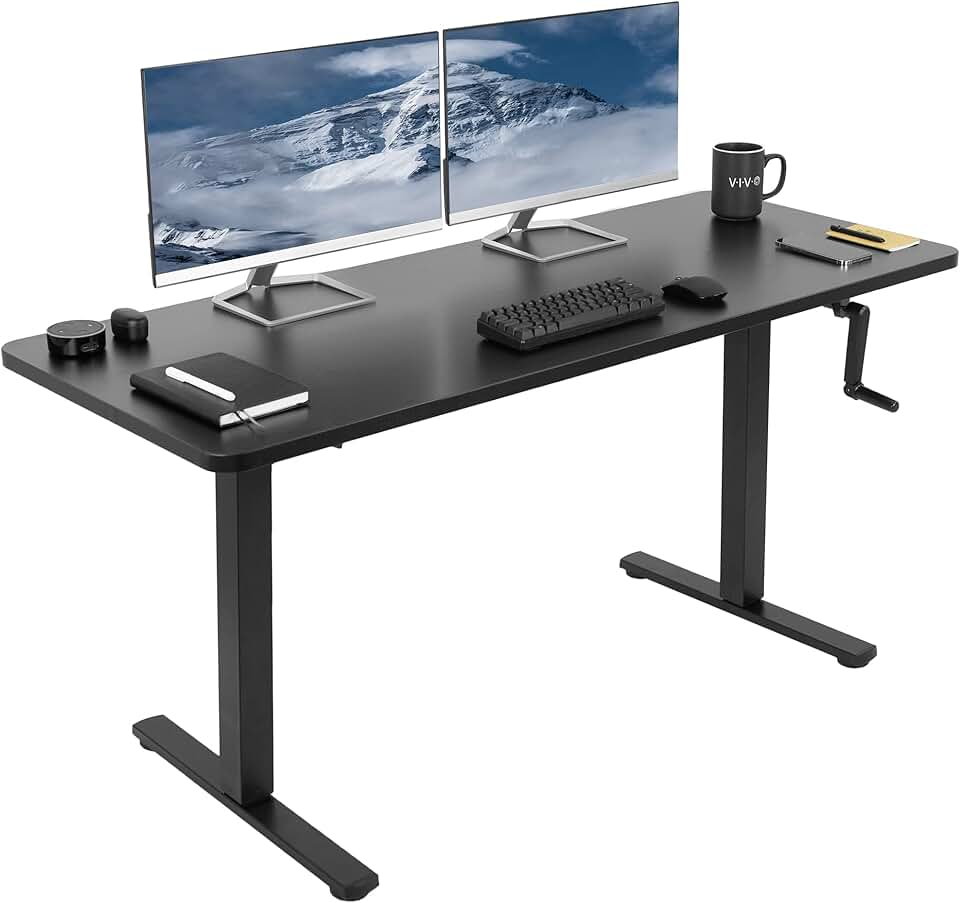
The VIVO Manual 60x24 uses a solid steel frame that does not flex noticeably under typical loads in the 80 to 100 lb range. The particle board top is a cost concession - it is not solid wood, and it will not survive a water spill the way a bamboo or MDF-with-laminate surface might. That said, at $219.99, particle board is the industry standard, and VIVO's laminate finish on the white and light wood variants holds up to daily keyboard and mouse friction without visible wear patterns in the first year. The all-black DESK-KIT-MB6B variant uses a matching dark top that hides minor scuffs better than the white option. The steel legs show no reported wobble complaints at seated height, and the telescopic mechanism feels mechanically solid when fully extended. Frame quality is meaningfully better than the generic $120 to $150 manual desks sold through Walmart and Newegg with no brand backing.
Comfort & Ergonomics
The 60-inch width is the single biggest ergonomic asset here. Two 27-inch monitors sit side by side with 3 to 4 inches of clearance, and there is still room for a notebook or small document tray on the right side. The 24-inch depth is adequate but not generous - a large desk mat, a keyboard, and a mouse pad fill it quickly. Users at or near 6 feet have confirmed sufficient standing height, but the exact adjustment range has not been officially published for this manual model. VIVO's electric 60x24 sibling reaches 29 to 48.8 inches, and the manual variant likely sits in a comparable range given the same frame architecture. The lack of height presets is the core ergonomic weakness: without a marker or tape measure, hitting the same standing height twice is guesswork, and inconsistent standing posture is meaningfully worse than no standing at all.
Adjustability
The side-mounted hand crank drives telescopic leg extensions on both sides simultaneously, which prevents the uneven-height problem that plagues cheaper single-crank designs. Adjustment speed is manual and user-dependent - expect 30 to 60 seconds to move from seated to standing height if you are turning at a comfortable pace. That is 3 to 5 times slower than VIVO's electric model at 38mm per second with button controls. If your workflow involves sitting for 90-minute blocks and standing for 30-minute blocks, this cadence is tolerable. If you want to pop up every 20 minutes, the crank will become a genuine daily annoyance. There are no cable management channels built into the manual version, unlike the electric siblings - plan your monitor and peripheral cables independently.
Assembly
VIVO ships all required hardware with the desk, and the instructions are step-by-step with labeled diagrams. Most users report a 45 to 75 minute solo assembly time. The one-piece top eliminates any alignment issues that come with split-top configurations. A second person is helpful but not strictly required - the 60-inch top is awkward to maneuver alone in a small room, but manageable. No special tools beyond the included hardware are needed. Cross-referencing user reports on the electric 60x24 variant, which shares frame geometry, confirms no systemic assembly errors or missing parts have been flagged.
Value for Money
At $219.99, this desk sits above the $120 to $200 generic manual crank tier and below the $300 to $400 electric tier. The 3-year warranty is the clearest signal that VIVO stands behind the product more firmly than unbranded competitors. The particle board top and 110 lb weight limit are the two areas where you feel the price constraint most directly. For a first standing desk in a home office where the user is not yet certain they will commit to a standing routine, spending $220 instead of $350 is a defensible hedge. If after 6 months you are standing 3 or more hours daily, the step up to VIVO's electric DESK-KIT-B06B or a comparable Flexispot E7 will feel justified. Think of this desk as a 12 to 18 month trial run, not a 10-year workstation investment.


