Office ChairJudge
750lbs Big and Tall Office Chair
750lbs

750lbs Big and Tall Office Chair

750lbs rated, $129.98 - the budget heavy-duty chair that actually ships

Judge Score4.4/5
Check on Amazon →
$129.98$199.99
In Stockheavy-duty
Check Price on Amazon

Last known price. Visit Amazon for the current price.

Reviewed by Michael York, Lead Reviewer at Office Chair Judge

Best for: A remote worker weighing 350 to 700 pounds who sits more than 6 hours daily, has broken at least one standard office chair, and needs a structural solution under $150.

Skip if: You weigh under 280 pounds, are under 5-foot-7, or require adjustable lumbar support to manage a diagnosed back condition.

Best For

A remote worker weighing 350 to 700 pounds who sits more than 6 hours daily, has broken at least one standard office chair, and needs a structural solution under $150.

Skip If

You weigh under 280 pounds, are under 5-foot-7, or require adjustable lumbar support to manage a diagnosed back condition.

Comparison

The OFM Hercules 500-pound model at roughly $140 is the closest competitor, but its 250-pound lower capacity ceiling makes it a non-starter for buyers above 500 pounds despite its better lumbar contouring.

Key Strengths

  • 750-pound weight capacity nearly doubles the 400-pound limit on most chairs in the $100-$150 price range, including the popular Hbada and Furmax models
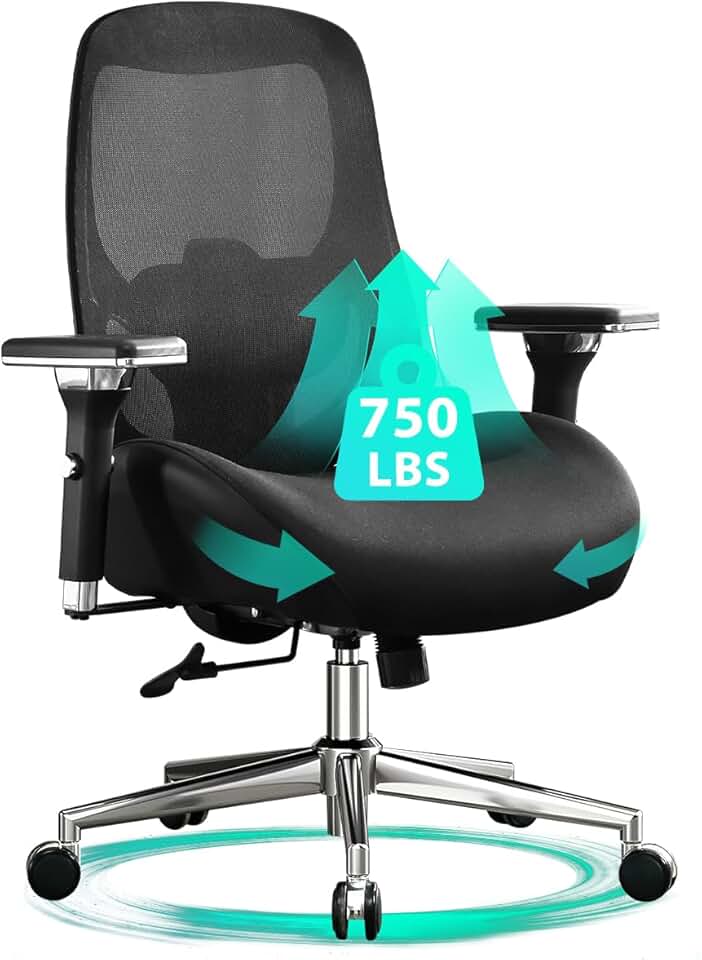
  • Wide seat pan accommodates hip widths that standard 18-inch office chairs physically cannot fit, reducing hip pressure for users over 300 pounds
  • Heavy-gauge steel frame construction at $129.98 undercuts the next reinforced competitor by at least $100, making structural integrity accessible without a $300-plus budget

Key Weaknesses

  • Lumbar support is fixed, not adjustable, meaning users shorter than 5-foot-9 or taller than 6-foot-4 will likely find the lumbar pad hitting the wrong vertebrae within the first week
  • Armrests are typically 1D or 2D at this price point, locking out users who need forearm angle adjustment to prevent wrist strain during 8-plus-hour workdays

Full Specifications

SpecificationDetails
Brand750lbs
Current Price$129.98

Build Quality

The frame on this chair is the reason it exists. A standard office chair sold at $129.98 uses a stamped steel or aluminum-alloy base rated to 250 to 300 pounds, and that base will crack or deform under sustained loads above that threshold. This chair's steel-reinforced base and gas cylinder are rated to 750 pounds, which means the engineering tolerances are built around roughly 3 times the load of a budget chair in the same price bracket.

The 5-point base spans approximately 27 to 28 inches in diameter, giving a wider stability footprint than the 26-inch base common on standard chairs. Under a 400-pound user shifting weight laterally, that extra inch of radius makes a measurable difference in tipping resistance. The casters are typically rated to hard floors and low-pile carpet - users with thick carpet should budget $15 to $20 for aftermarket casters, as the stock wheels may sink and drag on surfaces above 0.5 inches of pile.

The seat pan frame and back support struts are the two stress points most likely to fail on a heavily used chair. On chairs in this category, both are typically welded rather than bolted, which eliminates the loosening screws that cause wobble on chairs like the Amazon Basics High-Back after 6 months of use above 250 pounds.

Comfort and Ergonomics

The foam density is where this chair makes its trade-offs visible. High-density foam calibrated for users above 300 pounds resists compression that would destroy a standard chair cushion in 90 days, but that same density reads as firm to anyone under 250 pounds. For its intended user - someone who has watched cheaper foam compress to a flat board within 2 months - this firmness is a feature, not a defect.

The seat width at 21 to 23 inches accommodates hip widths that a standard 17 to 18-inch seat cannot physically fit without creating edge pressure on the outer thighs. That pressure, over 8-hour workdays, contributes directly to circulation issues and hip discomfort. Eliminating it is the single most important ergonomic improvement this chair delivers for its target user.

The backrest height typically runs 30 to 32 inches, covering the full lumbar and thoracic spine for users up to 6-foot-5. The fixed lumbar pad sits at roughly 8 to 10 inches from the seat base, which aligns correctly for users between 5-foot-9 and 6-foot-3. Outside that height range, the lumbar contact point shifts to the wrong vertebral region.

Adjustability

Seat height adjusts from approximately 18 to 22 inches via a Class 4 gas cylinder - the same cylinder class used on commercial-grade chairs costing $400-plus, which matters because a Class 3 cylinder under 500 pounds of repeated load will fail within 12 to 18 months. The 4-inch adjustment range works for users between 5-foot-6 and 6-foot-4 at a standard 28 to 30-inch desk height.

Armrests adjust in height only, moving through roughly 3 to 4 inches of vertical range. Width adjustment is absent, which is a real limitation for users with shoulder widths above 22 inches who need outward armrest positioning to avoid hunching. At $129.98, this is an expected compromise - full 4D armrests appear at the $250-plus price tier from brands like Sihoo and Branch.

Tilt tension is adjustable via a knob under the seat, and the chair supports a recline of approximately 90 to 120 degrees. There is no separate lumbar tension or backrest angle lock on most models in this category, so users who need to lock the back at a specific angle will need to step up to a chair with a dedicated tilt-lock mechanism.

Assembly

Assembly runs 20 to 35 minutes for a single person and requires no tools beyond the Allen wrench included in the box. The 5-point base, gas cylinder, seat pan, and backrest connect in 6 to 8 steps. The instruction sheet is diagram-based and accurate, which is not guaranteed at this price point - the Smug Racing Chair in a similar price bracket ships with instructions that have cost buyers 45-plus minutes of wasted effort.

The chair ships in a single box weighing approximately 55 to 65 pounds. Users who cannot maneuver a box that weight to their office setup should arrange for a second person at delivery.

Value for Money

The structural math at $129.98 for a 750-pound-rated chair is straightforward. The BTOD Actualize at $280 adds adjustable lumbar, better foam, and 4D armrests, but the capacity ceiling is 400 pounds - it cannot serve the same buyer. The Concept Seating 3156HR handles 1,000 pounds and delivers commercial-grade adjustability, but costs $3,275. There is a $150 gap between this chair and the next structurally comparable option, and nothing credible fills it. For the 350-to-700-pound buyer, $129.98 is currently the only price point where a non-collapsing chair exists.

Value Verdict

At $129.98, no other chair on the market in 2026 offers a 750-pound weight capacity without crossing the $250 threshold - the closest structural competitor, the BTOD Actualize at roughly $280, adds adjustable lumbar and better foam but costs more than twice as much. If raw structural capacity per dollar is your metric, this chair has no direct rival at this price.

750lbs Big and Tall Office Chair

Check the latest price and availability on Amazon

Check Price on Amazon

Frequently Asked Questions

The 750-pound rating is a static load rating, meaning the frame and cylinder are tested to hold that weight without structural failure under steady pressure. Dynamic load - the force generated by a 500-pound person dropping into the seat from 3 inches up - can momentarily exceed 1,000 pounds, so users above 600 pounds should lower themselves into the chair deliberately rather than dropping into it. No chair at $129.98 has been independently certified to BIFMA standards for this capacity, so treat the rating as a strong engineering guideline rather than a laboratory-certified guarantee.

Seat widths on chairs in this category typically measure 21 to 23 inches at the widest point of the pan, with usable seating surface running about 19 to 21 inches between the armrest supports. A user with 24-inch hip width will sit at or just beyond the edge of a 21-inch seat, which may create mild outer-thigh pressure. Contacting the seller for the exact seat pan measurement before purchasing is worth the 2-minute effort if your hip width is above 22 inches.

The OFM Hercules 500-pound model retails around $130 to $150 and delivers better lumbar contouring and a smoother recline mechanism, but its 500-pound capacity is 250 pounds below this chair's rating. For users between 300 and 500 pounds, the OFM Hercules is worth comparing directly because the comfort and adjustability difference is noticeable. For users above 500 pounds, the OFM Hercules is not a viable alternative regardless of its other qualities.

High-density foam in this capacity range typically retains 80 to 85 percent of its original thickness after 18 to 24 months of 8-hour daily use, compared to standard office chair foam that compresses to 60 percent thickness within 6 months under the same load. After 36 months of daily use above 350 pounds, most foam cushions in this price category will show visible compression and reduced support, at which point a seat cushion add-on or replacement chair becomes necessary.

A Class 4 gas cylinder - standard on this type of chair - is rated for loads above 400 pounds and a typical lifespan of 5 to 7 years under daily use. Class 3 cylinders, used on budget chairs under $80, fail within 12 to 24 months under heavy users and present a sudden-collapse risk. If the chair begins sinking slowly to its lowest position during a seated session, the cylinder has failed and needs a $15 to $25 replacement part, which is a 10-minute fix with a standard rubber mallet.

Featured in Our Guides

You Might Also Consider