Learn who qualifies for the home office tax deduction in 2026, how to calculate it, and which office equipment purchases are fully deductible. Updated for 2026.
As an Amazon Associate, we earn from qualifying purchases.
Home Office Tax Deduction Guide for 2026
If you work from home, you've probably wondered whether your rent, utilities, or that new ergonomic chair qualify for a tax write-off. The answer depends entirely on how you earn your income - and in 2026, the rules are strict, specific, and worth understanding before tax season arrives.
This guide covers everything self-employed workers, freelancers, and 1099 contractors need to know about claiming the home office tax deduction in 2026, including how to calculate it, what equipment qualifies, and how to document everything correctly.
Disclaimer - This article is for informational purposes only and does not constitute tax advice. Always consult a qualified tax professional or visit IRS.gov for guidance specific to your situation.
Who Actually Qualifies for the Home Office Tax Deduction in 2026
This is where a lot of people get tripped up, so let's be completely clear.
W-2 employees cannot claim the home office deduction in 2026. This restriction was introduced under the Tax Cuts and Jobs Act (TCJA) and remains fully in effect. It doesn't matter whether your employer requires you to work from home, whether you never set foot in a physical office, or whether you purchased thousands of dollars in office furniture out of pocket. If you receive a W-2, this deduction is off the table for you.
Self-employed individuals can qualify, including:
Freelancers and independent contractors receiving 1099 forms
Consultants, designers, writers, developers, and other remote professionals running their own businesses
The Two Core Eligibility Requirements
Even if you are self-employed, your home office must meet both of these IRS tests:
1. Exclusive and Regular Use
The space must be used solely and consistently for business. A kitchen table where you also eat breakfast does not qualify. A spare bedroom used as both a guest room and an office does not qualify. The IRS means it - the space must be dedicated entirely to work.
2. Principal Place of Business
Your home office must be where you conduct the majority of your business activities, or where you regularly meet clients, or where administrative and management tasks primarily take place. Even if you do some work elsewhere (job sites, client locations), your home office can still qualify as your principal place of business if it handles most of your scheduling, invoicing, and planning.
Expert Tip - Measure your dedicated workspace accurately and take dated photos each year. If you're ever audited, visual documentation of a clearly defined, exclusively-used business area can make a significant difference.
The IRS offers two calculation methods for self-employed taxpayers. You can choose whichever yields the larger deduction, but you must stick with your chosen method for that tax year.
Method 1 - The Simplified Method
This is the easiest approach. You multiply your home office square footage by $5 per square foot, up to a maximum of 300 square feet. The maximum possible deduction using this method is $1,500.
Example: Your dedicated home office is 200 square feet.
200 sq ft x $5 = $1,000 deduction
Example: Your home office is 400 square feet.
Capped at 300 sq ft x $5 = $1,500 deduction (maximum)
The simplified method requires minimal recordkeeping - you just need to know your square footage. You claim it directly on Schedule C, no additional forms required.
One important limitation - this deduction cannot exceed your net business income. If your business earned $800 in a given year, your deduction is capped at $800 with no carryover to future years.
Method 2 - The Regular (Actual Expense) Method
This method is more complex but often results in a larger deduction, especially for homeowners or those with high housing costs. It works by calculating what percentage of your home is used for business, then applying that percentage to your actual home expenses.
Step 1 - Calculate your business use percentage:
Divide your office square footage by your home's total square footage.
Example: 200 sq ft office in a 2,000 sq ft home = 10% business use
Step 2 - Apply that percentage to your actual expenses:
Expense Category
Annual Amount
Business Portion (10%)
Rent or mortgage interest
$18,000
$1,800
Utilities (electric, gas, water)
$3,600
$360
Homeowner's or renter's insurance
$1,200
$120
Internet (if not 100% deducted separately)
$960
$96
Home repairs and maintenance
$800
$80
Total Deduction
$2,456
In this example, the regular method yields $2,456 versus the simplified method's $1,000 - a meaningful difference.
For homeowners, the regular method also allows a depreciation deduction on the business portion of the home. However, this depreciation is subject to recapture tax when you sell the home, which is worth discussing with a tax professional.
You'll need to complete Form 8829 and attach it to your Schedule C when using the regular method. Detailed recordkeeping - receipts, utility bills, lease agreements - is essential.
Expert Tip - Run both calculations before filing. Many self-employed individuals in high-rent cities find the regular method yields double or triple the simplified method's result.
Side-by-Side Method Comparison
Aspect
Simplified Method
Regular Method
Rate
$5 per sq ft, max 300 sq ft
Actual costs x business %
Maximum Deduction
$1,500
No fixed cap
Records Required
Square footage only
All receipts and bills
Depreciation
Not allowed
Allowed (with recapture)
Mortgage Interest / Property Taxes
Fully deductible on Schedule A
Prorated between Schedule A and Schedule C
Excess Deduction Carryover
No carryover
Carries forward to next year
Form Required
Schedule C only
Form 8829 plus Schedule C
Best For
Small offices, simple situations
Larger spaces, high housing costs
Deducting Your Office Chair, Desk, Monitor, and Other Equipment
Here's excellent news for self-employed home workers - your office furniture and equipment are deductible separately from your home office deduction, and they don't have to meet the same square footage or exclusive use tests.
If you're self-employed and use equipment exclusively for business, it qualifies as a business asset deduction through one of two IRS mechanisms:
Section 179 Deduction
Section 179 allows self-employed individuals to immediately deduct the full purchase price of qualifying business equipment in the year it was purchased, rather than depreciating it over several years. For most home office equipment and furniture, this is the preferred approach.
Bonus Depreciation
100% bonus depreciation allows the same result - a full first-year deduction - and can be applied to new or used qualifying property.
What Equipment Qualifies
For self-employed individuals, virtually all dedicated home office purchases qualify:
Ergonomic office chairs - An investment like the Herman Miller Aeron ($1,395 - $1,795) or a mid-range chair like the Branch Ergonomic Chair ($504) is fully deductible if used exclusively for business
Standing desks and sit-stand desks - Products like the Flexispot E7 Pro ($499) or Uplift V2 ($649+) qualify as business furniture
Computer monitors - A dual monitor setup ($300 - $800) used for business is deductible
Keyboard, mouse, webcam, headset - All deductible as business equipment
Monitor arms and desk accessories - Fully deductible
Ergonomic accessories - Lumbar supports, footrests, and wrist rests for a standing desk or keyboard setup
Expert Tip - Keep your purchase receipts and document how each item is used for business. A simple note in a spreadsheet stating "purchased X for exclusive use in home office business" alongside the receipt date and amount is sufficient for most audits.
Equipment Deduction by Worker Type
Equipment
W-2 Employee
Self-Employed (1099 / Schedule C)
Ergonomic office chair
Not deductible
Fully deductible (Section 179 or bonus depreciation)
Standing desk
Not deductible
Fully deductible
Computer monitor
Not deductible
Fully deductible
Laptop or desktop computer
Not deductible
Fully deductible (business use %)
Webcam and headset
Not deductible
Fully deductible
Desk accessories
Not deductible
Fully deductible
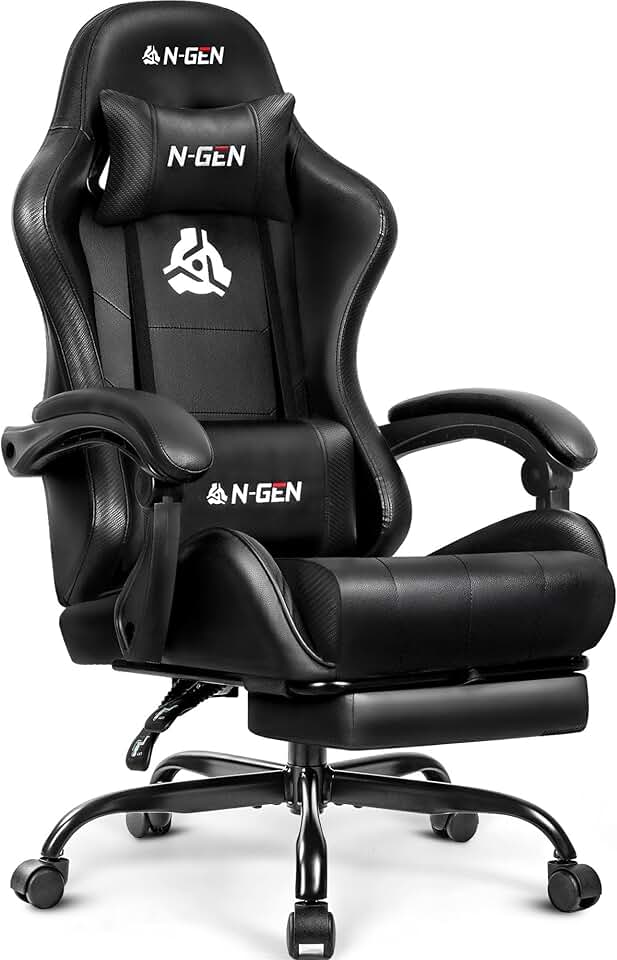
N-GEN Gaming Chair with Footrest
Solid starter chair with a footrest that falls short
Let's put this all together with a practical scenario.
Sarah is a freelance graphic designer earning $85,000 per year via 1099 income. She works from a dedicated 180 sq ft spare bedroom that contains nothing but her desk, chair, computer setup, and design equipment.
Home Office Deduction (Regular Method):
Home size - 1,800 sq ft total
Business use percentage - 180 / 1,800 = 10%
Monthly rent - $2,200 ($26,400/year) x 10% = $2,640
Utilities - $2,400/year x 10% = $240
Renter's insurance - $240/year x 10% = $24
Total home office deduction - $2,904
Simplified Method Alternative:
180 sq ft x $5 = $900
Sarah clearly benefits from the regular method here.
Sarah's total home office and equipment deductions - $5,052, reducing her taxable self-employment income significantly.
What W-2 Employees Can (and Cannot) Do in 2026
If you're a W-2 employee working from home, it's understandably frustrating to learn that none of your home office expenses are deductible at the federal level in 2026. This includes:
Rent or mortgage costs for your workspace
Utility bills
Internet costs (if not reimbursed)
Office furniture including chairs, desks, and monitors
Office supplies
However, there are a few things worth knowing:
Employer Reimbursements - If your employer reimburses you for home office expenses through an accountable plan, those reimbursements are typically tax-free to you. It's worth asking your HR department about this.
State Tax Rules - Some states have not conformed to the TCJA and may allow home office deductions for employees at the state level. Check your state's rules or speak to a local tax professional.
QBI Deduction for Side Gigs - If you have any self-employed income in addition to your W-2 job, you may qualify for a 20% Qualified Business Income (QBI) deduction on that self-employed portion, as well as equipment deductions tied to that side business.
Employee vs. Self-Employed - Full Comparison
Tax Benefit
W-2 Employee
Self-Employed (1099 / Schedule C)
Home office deduction
Not available
Available if qualified
Office furniture deduction
Not available
Section 179 or bonus depreciation
Internet and phone
Not deductible
Deductible (business %)
QBI deduction (20%)
Not available
Available
Health insurance deduction
Pre-tax via employer
Self-employed health insurance deduction
Retirement contributions
401(k) via employer
SEP-IRA, Solo 401(k), etc.
No tax on tips/overtime
New benefit in 2026
Not applicable
Ergonomic Office Chair with Footrest
Budget pregnancy chair that actually supports where it counts
The IRS requires that you substantiate any deduction you claim. For home office deductions, this means keeping:
Lease agreement or mortgage statements showing your home address and payment amounts
Utility bills for the entire year
Floor plan or measurements documenting your office space
Dated photos of your dedicated workspace
Equipment receipts with purchase dates, amounts, and vendor names
Business income records confirming the space was used for an active trade or business
A simple folder (physical or digital) with these documents organized by tax year is all you need. Cloud storage with a clearly labeled folder per year works perfectly.
Expert Tip - Never mix personal and business expenses in the same bank account or credit card if you're self-employed. A dedicated business account makes recordkeeping dramatically easier and looks cleaner if you're ever audited.
For 2026, a few numbers are worth keeping in mind:
The simplified method rate remains at $5 per square foot - there is no inflation adjustment built in
The standard deduction rose to $16,100 for single filers and $32,200 for married filing jointly - this means most taxpayers won't benefit from itemizing, which factors into how you handle the mortgage interest and property tax portions under the regular method
100% bonus depreciation continues to be available for qualifying equipment purchases, making same-year full deductions on office furniture and technology purchases straightforward
The QBI deduction of 20% for self-employed individuals remains in place
None of the fundamental home office rules changed between 2025 and 2026. The TCJA restrictions on employee deductions remain fully intact.
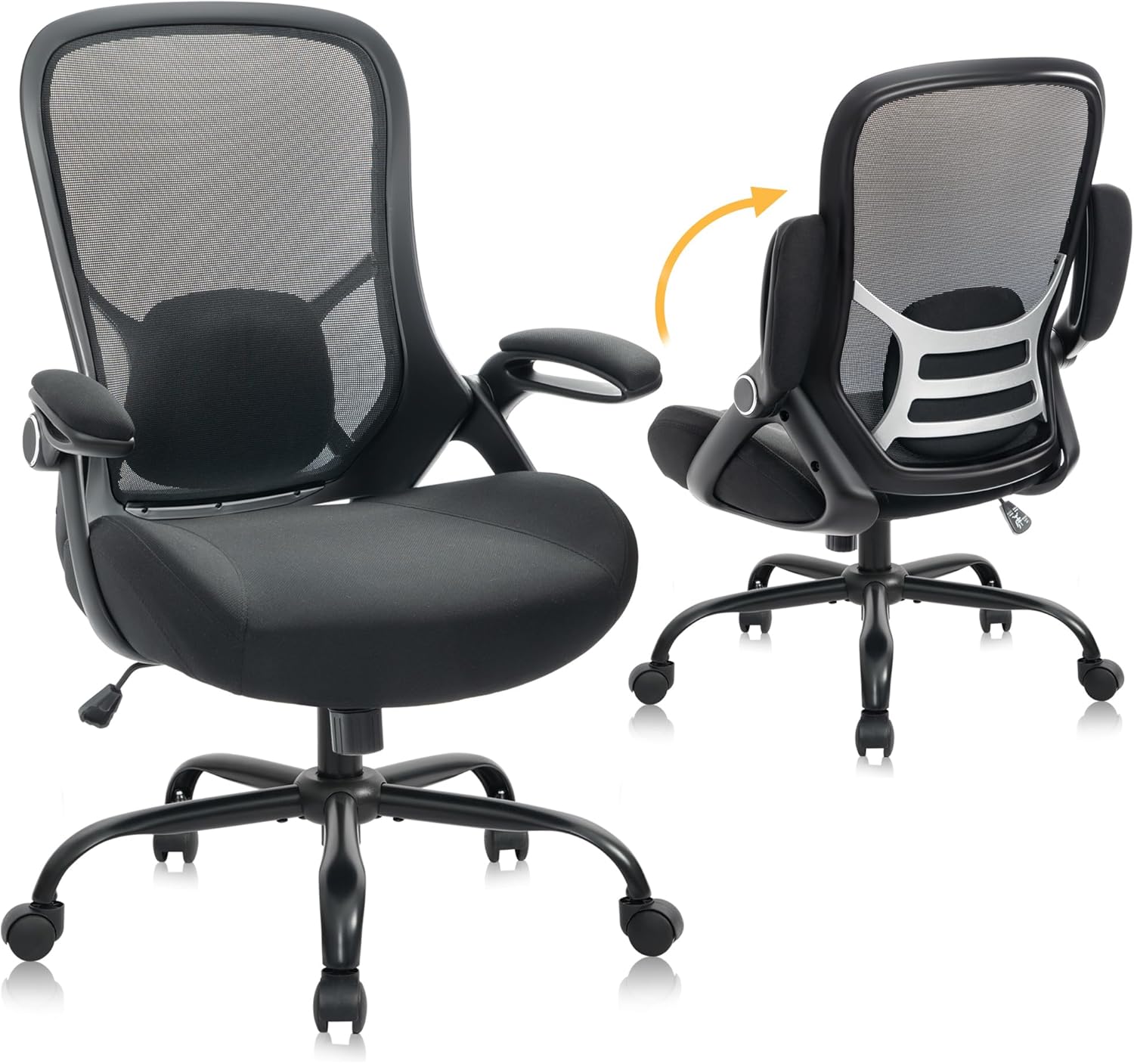
HYLONE Big Tall Heavy Duty Chair
A drafting chair that actually handles eight-hour shifts
The Best Home Office Investments for Self-Employed Workers in 2026
If you're self-employed and planning purchases that are fully deductible, it makes sense to invest in equipment that genuinely improves your productivity and health - because the after-tax cost is meaningfully lower than the sticker price.
Here are some categories worth considering, all of which qualify for Section 179 deduction for eligible self-employed workers:
Ergonomic Chairs - A quality ergonomic office chair supports long working hours and reduces injury risk. Options range from the Branch Ergonomic Chair at $504 to the Herman Miller Embody at $1,945. At a 22% federal self-employment tax bracket, a $1,000 chair effectively costs around $780 after deductions.
Standing Desks - A height-adjustable standing desk is one of the most impactful investments for home office health. Electric models from Flexispot ($399 - $799) and Uplift ($649+) are popular choices.
Monitor Arms and Accessories - A good monitor arm improves ergonomics and screen positioning, typically costing $30 - $150 and fully deductible.
Supportive Accessories - Lumbar support cushions, footrests, and ergonomic keyboard trays are all deductible and meaningfully improve comfort during long work sessions.
The key point - for self-employed individuals, the government is effectively subsidizing a portion of every legitimate business purchase. Buying better equipment isn't just a comfort decision, it's a financially smart one.
Summary - Home Office Tax Deduction Quick Reference
Question
Answer
Can W-2 employees deduct a home office?
No, not in 2026
Can self-employed workers deduct a home office?
Yes, if exclusively and regularly used for business
What's the simplified method maximum?
$1,500 (300 sq ft x $5)
Can I deduct my office chair?
Yes, if self-employed (Section 179 or bonus depreciation)
What form do I use?
Schedule C, with Form 8829 for the regular method
Can I carry forward unused deductions?
Only with the regular method
Do state rules differ?
Yes - check your specific state
The home office tax deduction is genuinely valuable for self-employed workers who qualify - potentially saving thousands of dollars per year when combined with equipment deductions. The key is understanding the rules, maintaining clean records, and making your calculations both ways before filing.
For personalized guidance, always work with a qualified CPA or tax professional who understands self-employment taxation.
Veken 55 Electric Standing Desk
Big desk, small price, smooth sit-stand transitions every time
No. W-2 employees cannot claim the home office deduction in 2026. The Tax Cuts and Jobs Act (TCJA) eliminated this deduction for employees, and those restrictions remain in effect. This applies even if your employer requires you to work from home full-time. Only self-employed individuals, freelancers, and sole proprietors filing Schedule C can claim this deduction.
If you are self-employed, yes - your office chair, standing desk, monitor, and other business equipment are fully deductible as business assets, typically through Section 179 or 100% bonus depreciation. This means you can deduct the full purchase price in the year you buy the item. W-2 employees cannot deduct these purchases. Products like the Branch Ergonomic Chair ($504) or a Flexispot standing desk ($399+) would qualify for self-employed individuals.
The simplified method lets you deduct $5 per square foot of your dedicated home office space, up to a maximum of 300 square feet. The maximum deduction using this method is $1,500. It requires minimal recordkeeping - just your square footage - and is filed directly on Schedule C without Form 8829. The rate has not changed for 2026. If your office is 200 square feet, your deduction would be $1,000.
The regular method calculates your actual home expenses and applies your business use percentage to them. You divide your office square footage by your home's total square footage to get your business percentage, then apply that percentage to your rent or mortgage interest, utilities, insurance, and other home costs. For example, a 200 sq ft office in a 2,000 sq ft home gives you 10% business use. You'd deduct 10% of all qualifying home expenses. This method requires Form 8829 and detailed records, but often results in a larger deduction than the simplified method.
It does not have to be a separate room, but it must be a clearly defined area used exclusively and regularly for business - with no personal use. A dedicated corner of a room with a desk used solely for work can qualify. However, a kitchen table where you also eat meals or a bedroom that doubles as a guest room would not qualify under the IRS exclusive use requirement.
If you are self-employed, you can deduct the business-use portion of your internet bill. If you use the internet for both personal and business purposes, you'd estimate a reasonable business percentage and deduct that amount. Many self-employed individuals deduct 50% to 80% depending on their situation. Internet used exclusively for business could be 100% deductible. This deduction is typically claimed separately on Schedule C rather than as part of the home office calculation.
You should keep lease agreements or mortgage statements, utility bills for the full year, home insurance documents, a measurement or floor plan showing your office square footage, dated photos of your dedicated workspace, and all equipment purchase receipts. For the regular method, you'll also need Form 8829. Organized digital or physical records stored by tax year are ideal. These records support your deduction if the IRS ever requests documentation.
Yes. For self-employed individuals, the home office deduction and business equipment deductions are completely separate. The home office deduction covers your share of rent, utilities, and home costs. Equipment like chairs, desks, and monitors are deducted as business assets through Section 179 or bonus depreciation, also on Schedule C. You can claim both in the same tax year, and both deductions are independent of each other.