Stretches for Desk Workers - The Complete 2026 Guide
If you spend most of your day sitting at a desk, your body knows it. Tight shoulders, a stiff neck, an aching lower back, and wrists that protest every keystroke are all classic signs that your muscles are crying out for movement. The good news? You do not need a gym, a yoga mat, or even a lot of time. The best stretches for desk workers can be done right at your workstation in just a few minutes a day.
This guide covers every major body area affected by prolonged sitting, gives you a ready-to-use 5-minute routine, and explains exactly how often to move so you stay comfortable and productive all day long. Whether you are working from a home office or a corporate cubicle, these stretches will make a real difference.
Why Desk Workers Need to Stretch Every Day
Prolonged sitting puts your body in a compromised position for hours at a time. Your hip flexors shorten, your chest tightens, your shoulders round forward, and the muscles along your spine switch off from lack of use. Over weeks and months, this leads to postural imbalances, chronic pain, and reduced mobility that can affect your life well beyond the office.
Regular stretching counteracts these effects by:
- Improving blood circulation to muscles and joints that are starved of movement
- Reducing muscle tension that builds up from static postures
- Maintaining joint range of motion so stiffness does not become permanent
- Lowering stress hormones - movement genuinely helps with mental fatigue too
- Preventing repetitive strain injuries in the wrists, neck, and shoulders
Consistency matters far more than intensity here. Short, regular stretch breaks beat one long session you never actually do.
Expert tip - Physical therapists consistently recommend treating stretch breaks like calendar appointments. Set a phone alarm or use a desktop reminder app every 30-60 minutes. Even one minute of movement per break adds up to meaningful relief across an eight-hour day.
How Often Should Desk Workers Stretch
This is the question most people get wrong. The answer is more often than you think, but for shorter periods than you might expect.
| Routine Type |
Frequency |
Duration |
Best For |
| Micro-break stretches |
Every 30-60 minutes |
1-2 minutes |
Preventing tension buildup |
| Full desk routine |
2-3 times daily |
5 minutes |
Overall mobility and relief |
| Targeted relief session |
As needed when pain strikes |
2-3 minutes |
Immediate stiffness or soreness |
The general guideline from health and occupational therapy sources is to take a 1-2 minute movement break every 20-30 minutes of continuous sitting. In practice, most people find every 45-60 minutes is realistic and still highly effective.
Do not wait until something hurts. Prevention is always easier than treatment.
Stretches for Desk Workers - Full Body Area Breakdown
Here is your complete reference for the most effective desk stretches, organized by body area. All of these can be done seated or standing at your desk. Hold each stretch for 10-30 seconds and repeat 3-5 times per side unless noted otherwise.
Neck Stretches for Desk Workers
Your neck carries the weight of your head - roughly 10-12 pounds - all day. Forward head posture from staring at a monitor places enormous strain on the cervical spine. These two stretches address that directly.
Chin Tucks
Sit tall with your back against your chair. Without tilting your head up or down, gently draw your chin straight back as if making a double chin. Hold for 5-10 seconds and release. This one movement restores proper neck alignment and decompresses the upper cervical vertebrae. It might feel awkward at first but becomes one of the most valuable habits you can build.
Neck Side Tilt
Sit upright and slowly tilt your right ear toward your right shoulder. Do not raise your shoulder to meet it - let gravity do the work. Hold for 20-30 seconds, feeling the stretch along the left side of your neck. Switch sides. For a deeper stretch, gently place your right hand on the left side of your head with no pressure, just the weight of your hand.
Expert tip - If you feel any sharp pain, tingling, or numbness during neck stretches, stop immediately and consult a healthcare provider. Mild tension release is normal; nerve symptoms are not.
Shoulder Stretches for Desk Workers
Rounding forward over a keyboard all day tightens your pectoral muscles and weakens the muscles between your shoulder blades. These stretches help restore balance.
Shoulder Rolls
Lift both shoulders up toward your ears, roll them back and down in a smooth circle. Do 10 repetitions backward, then 10 forward. This simple move breaks up the static tension that accumulates in the upper trapezius and helps reset your posture without you even having to stand up.
Chest and Shoulder Opener
Clasp your hands together behind your lower back. Straighten your arms, squeeze your shoulder blades together, and gently lift your arms while pushing your chest forward and upward. Hold for 20-30 seconds. This is the antidote to rounded shoulders and is one of the most satisfying stretches in the entire routine once you feel it open up.
Cross-Body Shoulder Stretch
Bring your right arm across your chest at shoulder height. Use your left hand to press it gently closer to your chest. Hold for 20-30 seconds, then switch. This targets the posterior shoulder capsule, which gets compressed during long typing sessions.
Back Stretches for Desk Workers
The mid and lower back suffer the most from prolonged sitting. These three stretches address the thoracic spine, lumbar spine, and the muscles that run along your entire back.
Thoracic Spine Extension
Sit at the edge of your chair. Place both hands behind your head with elbows wide. Gently arch your upper back over the top of your chair back, looking slightly upward. If your chair does not have a good backrest for this, clasp your hands and extend them overhead, then lean back slightly. Hold for 10-15 seconds and repeat 3-5 times. This is the single most effective stretch for the mid-back hunch that develops from desk work.
Seated Spinal Twist
Sit tall with both feet flat on the floor. Place your right hand on your left knee and your left hand on the back of your chair or armrest. Gently rotate your torso to the left, keeping your hips square. Turn only as far as feels comfortable - this should feel like a release, not a strain. Hold 20-30 seconds and switch sides. Spinal rotation improves mobility and helps move nutrient-rich fluid through the discs.
Reach for the Sky
Interlock your fingers and extend both arms overhead, palms facing the ceiling. Straighten your arms as much as possible and feel your spine elongating. Lean very slightly to the right to add a lateral stretch, hold, then lean to the left. This one feels incredible after a long stretch of focused typing work.
Hip Stretches for Desk Workers
Tight hip flexors and glutes are perhaps the biggest consequence of sitting for hours. When your hips are tight, the strain often transfers to your lower back - which is why so many desk workers experience lumbar pain even when it originates in the hips.
Figure-4 Glute Stretch
Sit upright in your chair. Cross your right ankle over your left knee, forming a figure-4 shape with your legs. Sit tall and gently lean your torso forward from the hips - not by rounding your back - until you feel a stretch deep in your right glute. Hold for 30 seconds, then switch. This is one of the most powerful desk stretches for lower back pain relief because it targets the piriformis, a deep muscle that often contributes to sciatic discomfort.
Seated Hip Flexor Stretch
Move to the edge of your chair. Slide your right leg back so your right foot is behind you with your toe on the ground, like a shallow seated lunge. Keep your torso upright and gently press your right hip forward. You should feel a stretch at the front of your right hip. Hold for 20-30 seconds and switch. If space allows, stand up and do a standing lunge against your desk for a deeper version.
Standing Hip Circles
Stand next to your desk, feet hip-width apart, hands resting on the surface for balance. Make slow, deliberate circles with your hips - 10 in each direction. This mobilizes the hip joints and the lumbar spine simultaneously and only takes about 30 seconds.
Wrist and Hand Stretches for Desk Workers
Repetitive typing and mouse use put enormous cumulative strain on the tendons, nerves, and muscles of the wrists and forearms. These stretches are your best defense against carpal tunnel syndrome and general wrist pain.
Wrist Extension Stretch
Extend your right arm in front of you with your palm facing away, fingers pointing up. Use your left hand to gently pull your fingers back toward you. Hold for 20-30 seconds, feeling the stretch along the inside of your wrist and forearm. Switch hands.
Wrist Flexion Stretch
Extend your right arm with palm facing toward you, fingers pointing down. Gently press your fingers toward you with the opposite hand. This stretches the top of the wrist and forearm, the area that takes the brunt of keyboard work.
Finger Spreads and Fists
Spread your fingers as wide as possible for 5 seconds, then make a gentle fist for 5 seconds. Repeat 10 times. This pumps circulation into the small muscles of the hand and reduces the tension that comes from gripping a mouse for extended periods.
Your 5-Minute Desk Stretch Routine
This is the full routine you can do 2-3 times daily - morning, midday, and late afternoon work perfectly. No equipment needed, no need to leave your desk.
Minute 1 - Neck
- Chin Tucks - 10 slow reps
- Neck Side Tilt - 30 seconds each side
Minute 2 - Shoulders
- Shoulder Rolls - 10 reps backward, 10 forward
- Chest Opener - 30 seconds
Minute 3 - Back
- T-Spine Extension - 5 reps of 10-second holds
- Seated Spinal Twist - 30 seconds each side
Minute 4 - Hips
- Figure-4 Glute Stretch - 30 seconds each side
- Seated Hip Flexor Stretch - 20 seconds each side
Minute 5 - Wrists and Hands
- Wrist Extension - 20 seconds each side
- Wrist Flexion - 20 seconds each side
- Finger Spreads - 10 reps
Expert tip - Do not rush through this routine. The stretches only work if you actually reach and hold the position of mild tension, not pain. Slow, controlled movement with full breathing gets three times the benefit of quick, half-hearted stretching.
The Every-30-Minutes Micro-Break Routine
If you cannot fit a full 5-minute routine three times a day, the micro-break approach is arguably more effective for preventing tension from accumulating. Pick 2-3 stretches from the list below and rotate through different ones throughout the day.
Best micro-break combos by symptom:
| Symptom |
Quick Fix Combo |
Time Needed |
| Stiff neck and headache |
Chin Tucks + Neck Tilt |
90 seconds |
| Shoulder tension |
Shoulder Rolls + Chest Opener |
90 seconds |
| Lower back ache |
Seated Twist + Figure-4 |
90 seconds |
| Wrist and finger fatigue |
Wrist Extension + Flexion + Finger Spreads |
60 seconds |
| General whole-body reset |
Reach for the Sky + Hip Circles |
60 seconds |
Setting a recurring timer on your phone or using a free app like Stretchly (desktop, free) or Stand Up (iOS, $2.99) makes this habit almost effortless to maintain.
Making Your Workspace Work With You, Not Against You
Stretching is most effective when your workstation is also set up to minimize strain in the first place. The best stretches for desk workers reduce pain that builds up during the day, but an ergonomic setup reduces how much pain builds up to begin with.
A few key areas to address alongside your stretching routine:
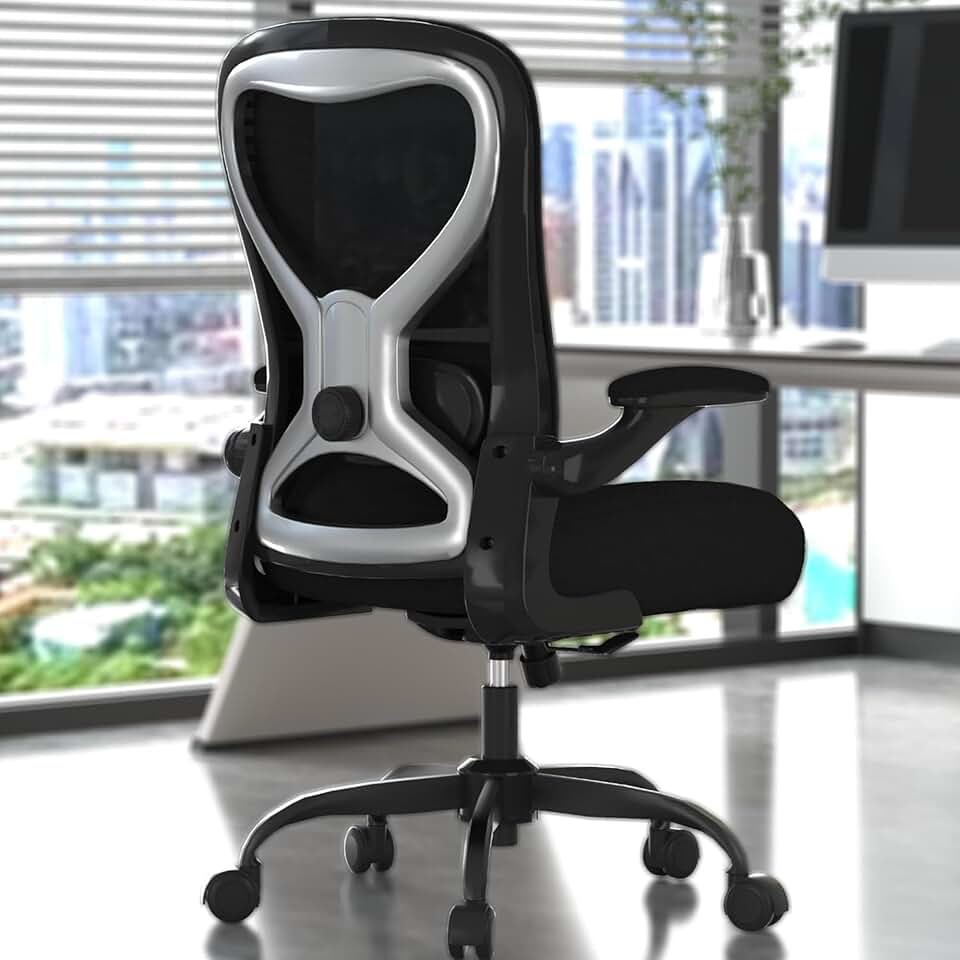
Chair setup - Your chair is the foundation of your posture. If you are sitting in a chair that does not support your lumbar spine, does not let your feet rest flat, or positions your arms at the wrong height, stretching can only do so much. Check out our guide to the best ergonomic office chairs for options at every budget, from the Herman Miller Aeron at around $1,795 to the highly rated Autonomous ErgoChair Pro at $499.
Monitor height - Your monitor should be at eye level so your neck stays neutral. If you are looking down at a laptop all day, a laptop stand paired with an external keyboard is one of the most impactful ergonomic changes you can make for around $30-$80.
Footrest - If your feet do not comfortably reach the floor in your current setup, a footrest reduces lumbar strain significantly. Budget options like the Humanscale FR500 retail around $65.
Standing desk mat - If you use a standing desk and alternate between sitting and standing, an anti-fatigue mat makes standing periods much more sustainable. See our review of standing desk mats for the top picks.
For a full posture improvement plan, our guide on improving posture at a desk walks through monitor positioning, lumbar support, and arm height in detail.
Common Mistakes Desk Workers Make When Stretching
Stretching into pain - There is a clear difference between the productive sensation of a muscle being lengthened and sharp or pinching pain. Never push into pain. Stretching should feel like mild, releasing tension.
Holding your breath - Tension and breath-holding go together instinctively. Make a deliberate effort to breathe slowly and deeply through every stretch. Exhaling into a stretch increases your range of motion and helps your nervous system relax the muscle.
Only stretching when something hurts - Reactive stretching helps but consistent daily stretching prevents the problem from recurring. Build the habit before you are in pain.
Rushing through holds - A 5-second hold does not give your muscle enough time to respond. Aim for a minimum of 20 seconds on most holds, and 30 seconds for the hips and thoracic spine.
Ignoring one side - Most people have postural asymmetries from mouse use, phone habits, or dominant hand preferences. Always stretch both sides even if one side feels fine.
When Stretching Is Not Enough
Stretches for desk workers are genuinely effective for everyday stiffness and tension prevention. However, there are situations where self-directed stretching should be accompanied by professional guidance.
See a healthcare provider if you experience:
- Pain that radiates down your arm or leg
- Numbness or tingling in your hands, fingers, or feet
- Pain that gets worse with stretching rather than better
- Persistent pain that does not respond to 2-3 weeks of consistent stretching
- Any sudden onset of severe pain
A physical therapist can assess your specific movement patterns and prescribe targeted exercises that go beyond general desk stretches. Many offer telehealth sessions, making this more accessible than ever in 2026.
Quick Summary - Stretches for Desk Workers
- Target neck, shoulders, back, hips, and wrists daily
- Hold each stretch 20-30 seconds, repeat 3-5 times per side
- Take a 1-2 minute stretch break every 30-60 minutes
- Do the 5-minute full routine 2-3 times daily for best results
- Pair stretching with a properly set up ergonomic workstation
- If pain persists beyond a few weeks, consult a physical therapist
Your body was not designed to sit still for eight hours a day. These stretches are a simple, free, and immediate way to fight back against the physical cost of desk work - and you can start right now, even before you finish reading this sentence.