Build Quality
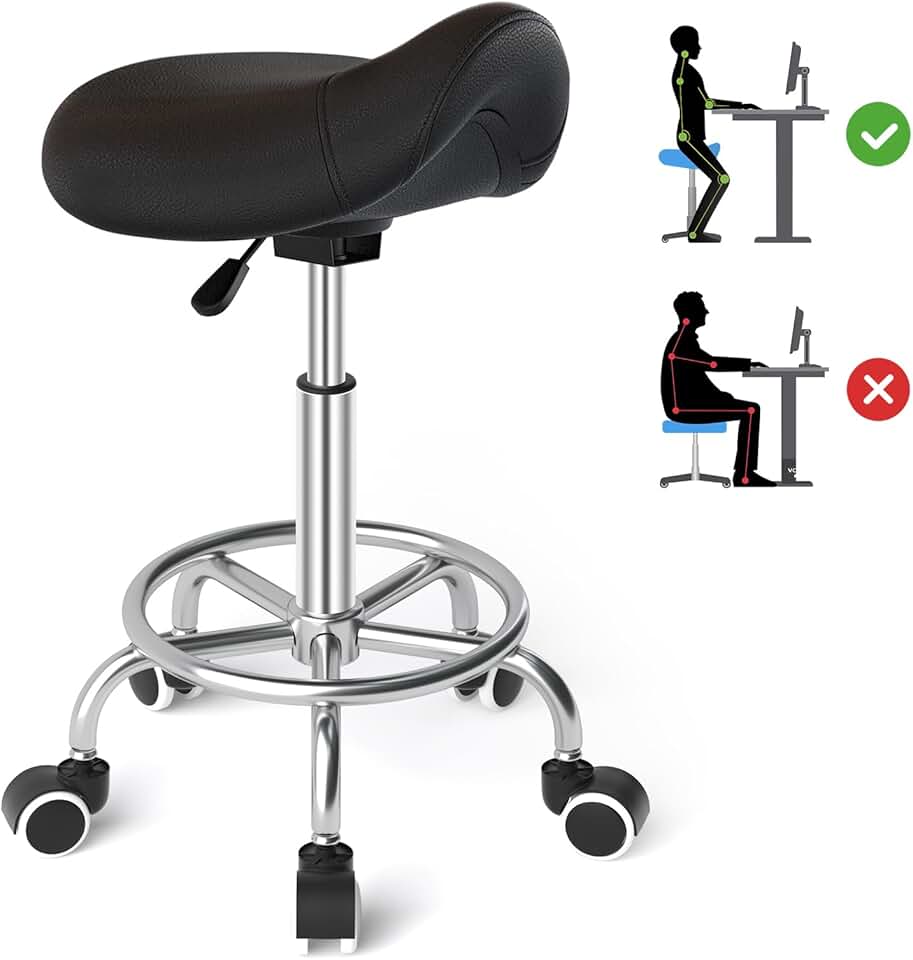
At $159, you are not getting Humanscale's 5-cylinder base or the triangle contour cushion that justifies a $338 price tag. What you get is a hydraulic gas-lift cylinder, a rolling caster base, and a saddle-shaped seat - the three components that actually do the ergonomic work. The PU leather upholstery is standard at this price point; the HOMCOM at $49.99 uses the same material, and the difference is in the foam density underneath it. Expect the seat to compress noticeably over the first 30 days of daily use. That is not a defect - it is what PU foam does. Plan for it.
The caster base is the build component most likely to show wear first. Five-caster bases distribute load more evenly than four-caster versions; confirm which configuration ships before buying. On hard floors, plastic casters will scratch over time - rubber-coated casters extend floor life significantly. If the product page does not specify caster material, email support before ordering.
Comfort and Ergonomics
The saddle shape does one thing better than any flat seat on the market: it tilts your pelvis forward between 10 and 15 degrees passively, without adjustment knobs or lumbar inserts. That tilt reestablishes the lumbar curve that a standard chair erases within 20 minutes of sitting. For users with chronic lower-back pain from desk work, the relief is often noticeable within the first week.
The tradeoff is weight distribution. A standard chair spreads load across your entire seat and thigh. A saddle concentrates pressure on your sit bones and inner thighs, which causes discomfort if you sit still for extended periods. The ergonomic benefit of a saddle stool depends on movement - small shifts, weight transfers, micro-adjustments every 15-20 minutes. Users who lock in and stare at a screen for 90-minute stretches will find this chair increasingly uncomfortable. The LIFEFORM, which targets the same posture correction and includes tilt-lock for users who need static seating phases, may be worth the extra $40-140 for those users.
For users between 4'0" and 6'0", the height range should accommodate seated work at surfaces between 28" and 36" high. Measure your workstation before buying.
Adjustability
Hydraulic height adjustment is the primary control here. Pump the lever to raise, sit to lower - standard pneumatic operation that takes under 10 seconds to dial in. There is no documented tilt-lock or tilt-tension adjustment in the available specs, which puts this chair behind the LIFEFORM and the Humanscale Freedom in configurability. If you need to lock the seat at a fixed angle for precision hand work - dental, drafting, or jewelry making - the absence of tilt-lock is a real limitation.
The Humanscale Freedom at $338 offers three cylinder options (low, standard, tall) plus optional 18" and 20" foot rings for users at extreme height ranges. At $159, those options are not available here. For users in the 5'2" to 5'10" range at a standard 30"-34" counter, that will not matter. Outside that range, it might.
Assembly
Saddle stools typically require 10-15 minutes of assembly: attach the cylinder to the base, attach the seat to the cylinder top, and test the height mechanism. No tools are usually required beyond what ships in the box. If the product arrives with a loose cylinder fitting or a caster that does not click fully into the base star, do not use it until those connections are secure - those are the two failure points that cause tip-overs.
Value for Money
The $159 price point is the strongest argument for this stool. The Perch at $265 and the Humanscale Freedom at $338 both deliver better adjustability and more durable materials, but neither delivers ergonomic outcomes that are $106 or $179 better for average users. The HOMCOM at $49.99 is too cheaply built for daily professional use. The SitHealthier at $179.95 adds tilt adjustment for $21 more. If tilt matters to your workflow, spend the $21. If it does not, $159 is a rational price for the core saddle-chair benefit.