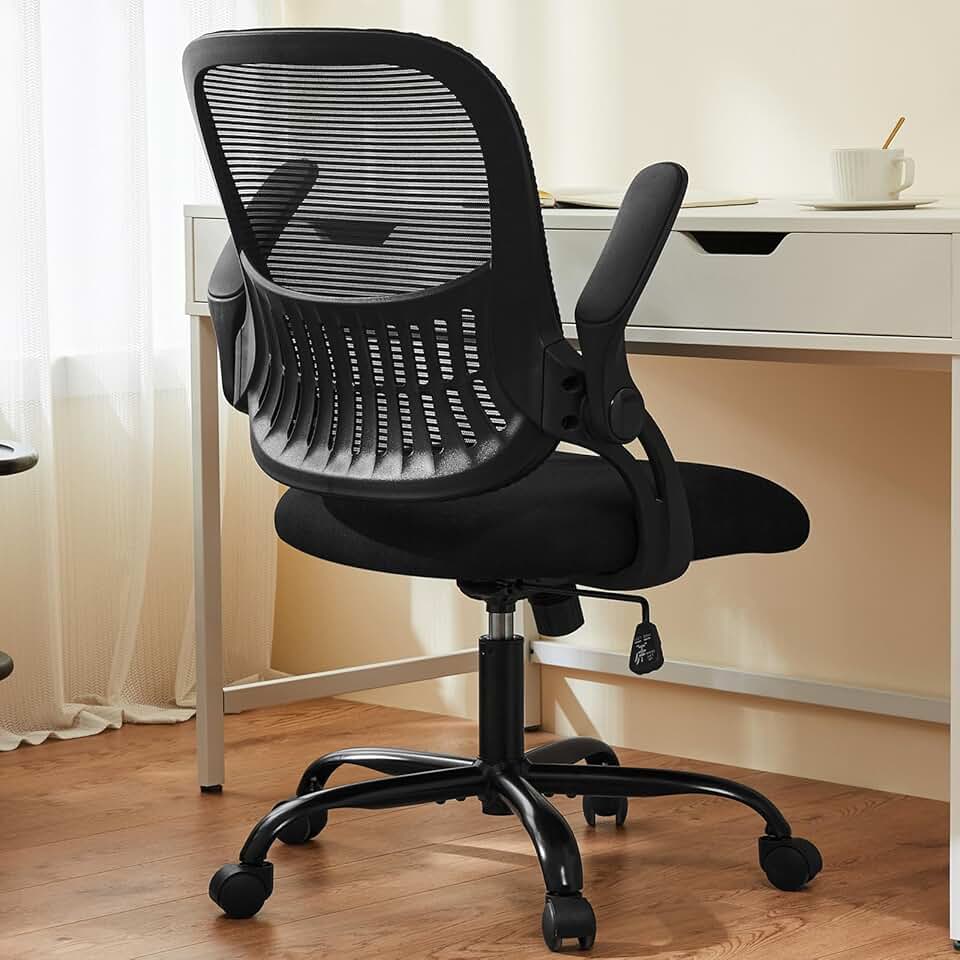
Build Quality
For $38.98, you are getting a chair that weighs somewhere in the 20-25 lb range typical of budget mesh task chairs, with a plastic frame, a five-point nylon base, and basic caster wheels. No steel internal frame is advertised, and BestOffice has not published tensile strength data or a specific weight capacity for this model. There are no recorded recalls or quality control scandals attached to this line as of 2026, but the absence of bad news is not the same as a good reputation - the brand simply lacks the review volume to generate either. Expect the plastic components to show wear within 18-24 months under daily use. The Corsair TC100, at 3-4 times the price, uses a sturdier construction with a documented 264 lb capacity and a 2-year warranty. BestOffice publishes no warranty terms for the $38.98 tier.
Comfort & Ergonomics
The mesh back provides genuine airflow that foam-backed chairs at this price cannot replicate - this is the single legitimate ergonomic win here. The lumbar support is a fixed bump, not an adjustable bladder or flexible panel. It will hit correctly for people in the 5'4" to 5'9" range sitting with average proportions. Anyone taller, shorter, or with a longer torso will find the lumbar placement misaligned within an hour. The seat cushion density is not published, but budget chairs in this category typically compress noticeably within 6 months of daily use. For sessions under 4 hours, the discomfort curve stays manageable. Beyond 5 hours, the lack of fine-tuned support becomes a physical problem, not just an inconvenience. The Steelcase Leap's LiveBack technology dynamically adjusts to your spine position throughout the day - that chair costs $1,000 more, but it is solving a fundamentally different problem.
Adjustability
Seat height adjusts via a standard pneumatic lever, which is functional and reliable at this price point. That is where adjustability ends. There is no documented tilt lock, tilt tension control, seat depth adjustment, or armrest customization. The armrests, if included on this configuration, are fixed in position. Compare this to the Corsair TC100's basic but present lumbar pillow positioning, or any mid-tier chair with 2D armrests, and the gap is obvious. If your daily work posture varies - if you lean forward for writing and recline for calls - this chair has no mechanical response to those changes. You are adjusting yourself around the chair rather than the chair adjusting to you.
Assembly
Budget mesh chairs in this category typically assemble in 20-30 minutes with a single Allen wrench included in the box. The five-point base attaches to the gas cylinder, the cylinder inserts into the seat mechanism, and the back panel bolts to the seat - usually 6 to 8 bolts total. BestOffice does not publish step counts or estimated assembly time, but no reviewers have flagged this line for unusually poor instructions. Expect standard flat-pack complexity, nothing more.
Value for Money
At $38.98, this chair occupies a category where almost no competition exists at the same price. The next credible option - the Corsair TC100 Relaxed at approximately $150-$200 - costs 4 to 5 times more and delivers a 264 lb weight capacity, a 2-year warranty, and presence in actual 2026 review rankings (where it scores 3 out of 5 stars). The BestOffice at $38.98 wins the price comparison automatically but loses every other metric. The honest math is this: if you sit in this chair for 500 hours over a year, you are paying under $0.08 per hour for seating. If it fails at month 10, that cost doubles - and you still have no warranty to fall back on. For a secondary guest desk or a student's first apartment, the arithmetic works. For a primary work setup, spend $150 or more and buy something with a documented capacity and a warranty.